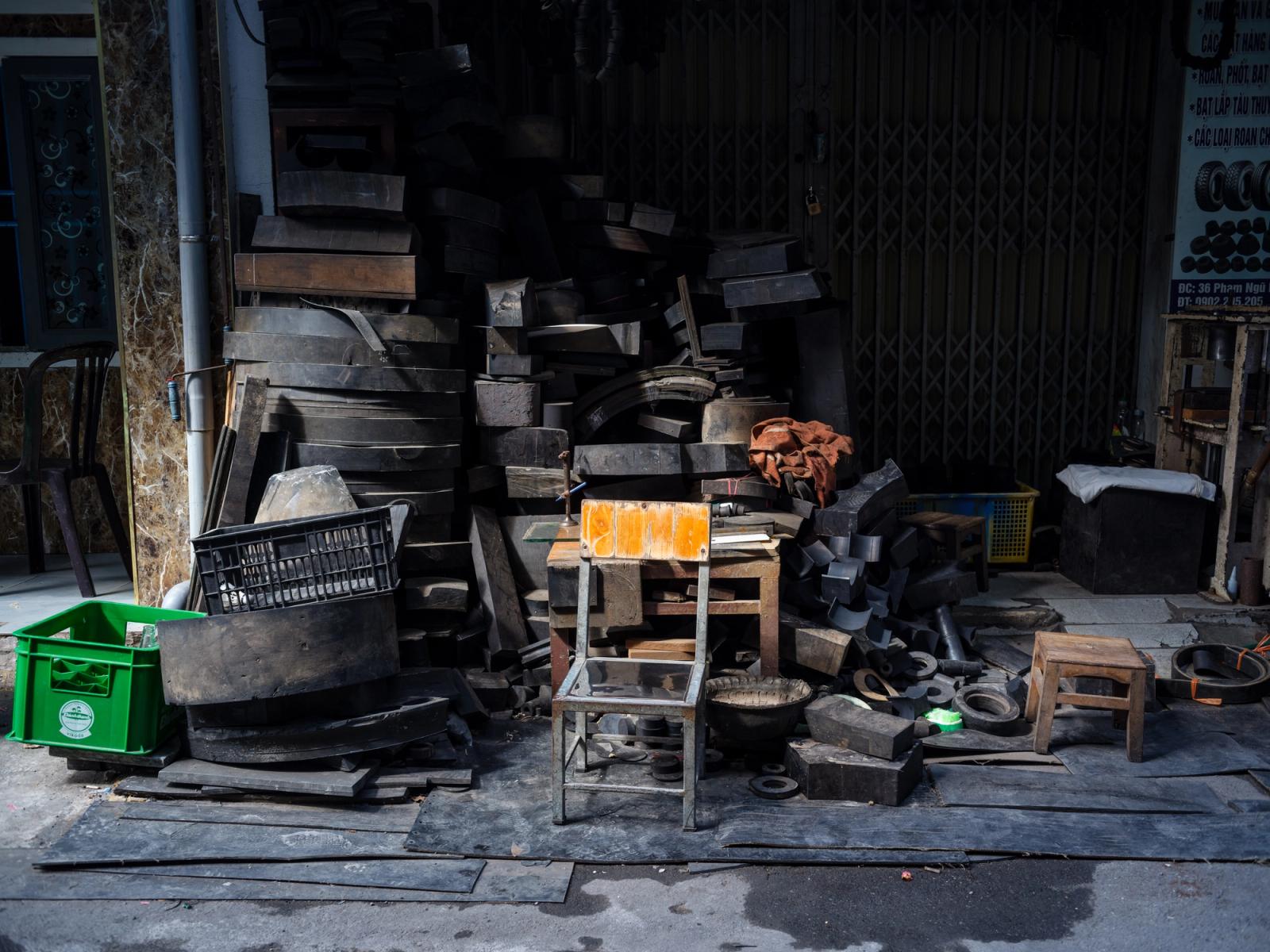
Vietnamese Everyday Works

Việc Nam is a linguistic play on Việt Nam. In Vietnamese, việc means work, task, matter, or action. From this perspective, the project approaches Việt Nam through its everyday practices: the tools, gestures, and ways of making that inform and give form to Việc Nam—Vietnamese Works.

“Việc Nam” is a platform to examine, exhibit, and archive everyday Vietnamese vernacular products (the what), production (the how), and purpose (the why).

Conceptualized as a series, with each investigating a single daily routine—cutting, cleaning, carrying, etc.—and the local tools, craftspeople, and supply chain that facilitate it.

Economic development, technological advancement, and international trade may render these tools obsolete. The same forces and other cultural factors may alter the daily routines. Our project’s purpose is to document them before the time comes.

Objects

Objects, when read through their surfaces, materials, and traces of use, can reveal the histories embedded within them. These often untold or difficult-to-perceive stories tell us where they come from, where they have circulated, who extracted the resources that made them possible, and how people transformed inherited or exploitative systems into objects of everyday use, survival, and agency.

Arturo Escobar argues that “designs from the south were always there, albeit with other names, we are just starting to perceive them. It takes time to recognize them.”1 Yet because design remains deeply tied to a modern Western epistemology, he asks: “Why use the word design at all, especially for nonmodern contexts?”2 This question invites us to consider whether practices of making, repairing, cultivating, and worldmaking that emerge outside Western modernity should be understood through the language of design, or whether doing so risks subsuming them within the very framework that has historically marginalized them.

Within Eurocentric frameworks, few distinctions are made to recognize non-Western singularities. As Stuart Hall points out, “vis-à-vis the developed West, we are very much ‘the same.’ We belong to the marginal, the underdeveloped, the periphery, the ‘Other.’ We are at the outer edge, the ‘rim,’ of the metropolitan world, always ‘South’ to someone else’s El Norte.”3 Rather than treating the margin and the periphery as secondary positions, Việc Nam foregrounds Việt Nam as one among many centers: sites from which objects, practices, forms of knowledge, and their politics can be understood through the worlds that produced them.

Objects are central to this approach because they offer another way of telling history. They carry gestures, routines, materials, economies, and relations within them. When read beyond their apparent function, they reveal how techniques circulate, who uses them, who repairs them, who adapts them, and how they become embedded in everyday life.

For Việc Nam, objects are not collected as isolated artifacts, but as vehicles for stories often absent from dominant histories of design. A knife, a basket, a stool, a lunch box, a street sign, or a tool may appear ordinary, but each one holds traces of use, labor, adaptation, survival, and collective intelligence. These objects make visible forms of knowledge that are practical, embodied, and often unnamed: ways of cutting, carrying, cleaning, cooling, and moving through and making the world. Việc Nam shifts design away from Eurocentric conceptions of rationalization, homogeneity, optimization, disposability, and universal standardization, toward resourcefulness, heterogeneity, multiplicity, adaptation, repair, and situated knowledge.

  1. 1 Alfredo Gutiérrez Borrero cited in Escobar, Arturo, ed. Designs for the Pluriverse: Radical Interdependence, Autonomy, and the Making of Worlds. Duke University Press, 2018, 206 ↩
  2. 2 Escobar, Arturo, ed. Designs for the Pluriverse: Radical Interdependence, Autonomy, and the Making of Worlds. Duke University Press, 2018, 213 ↩
  3. 3 Stuart Hall, “Cultural Identity and Diaspora [1990],” in Selected Writings on Race and Difference, ed. Paul Gilroy and Ruth Wilson Gilmore, Duke University Press, 2021, 263. ↩

Archives

What enters galleries, museums, and institutions—what is deemed worthy of being archived—has historically been shaped by cultural hegemony: by those with the authority to define what counts as valuable. Within this hierarchy, objects associated with Western modernity are often recognized as innovative, precise, authored, and “designed.” At the same time, material practices from colonized and formerly colonized contexts are more readily categorized as traditional, anonymous, manual, “craft,” or “folklore.”

At the center of this distinction is the question of authorship. The Western design canon tends to privilege the named designer and the claim of origin over the object, while overlooking forms of collective knowledge embedded in repeated gestures, local materials, inherited techniques, repair, adaptation, and everyday use. Việc Nam responds to this hierarchy by treating Vietnamese everyday objects as works of design shaped by many hands, habits, and contexts.

Who gets called a designer? Which objects are archived? Which forms of intelligence are recognized? Which are confined to categories such as craft or folklore? Through their collections and programming, museums shape what the public sees, but also what it does not see.

Erasure is a sovereign action; it decides what and who matters. As Michel-Rolph Trouillot reminds us, “the silencing of the past inheres not only in what is said but also in how it is said.”1 To archive these objects is therefore to respond to an absence: to gather what has often existed outside institutional recognition, and to value what has long been overlooked. For Việc Nam, archiving does not mean fixing objects as static artifacts. An object is always in motion: through the actions it enables, the gestures it requires, the materials and techniques that bring it into being, and the transformations through which it is repaired, adapted, replaced, or carried into another form. Archiving means recognizing its cultural, social, and political value before it disappears, remains unnamed, or evolves into another form.

  1. 1 Michel-Rolph Trouillot, “North Atlantic Universals: Analytical Fictions, 1492-1945,” The South Atlantic Quarterly (Durham) 101, no. 4 (2002): 847. ↩

Documentation

Through an inventory of objects photographed on a white background, Việc Nam borrows the conventions of museum collections, design catalogues, and institutional classification systems. Yet it departs from these traditions by refusing hierarchies between high and low culture, designed and undesigned objects, formal and informal modes of production.

Arturo Escobar argues that “designs from the south were always there, albeit with other names, we are just starting to perceive them. It takes time to recognize them.”1 Yet because design remains deeply tied to a modern Western epistemology, he asks: “Why use the word design at all, especially for nonmodern contexts?”2 This question invites us to consider whether practices of making, repairing, cultivating, and worldmaking that emerge outside Western modernity should be understood through the language of design, or whether doing so risks subsuming them within the very framework that has historically marginalized them.

Within Eurocentric frameworks, few distinctions are made to recognize non-Western singularities. As Stuart Hall points out, “vis-à-vis the developed West, we are very much ‘the same.’ We belong to the marginal, the underdeveloped, the periphery, the ‘Other.’ We are at the outer edge, the ‘rim,’ of the metropolitan world, always ‘South’ to someone else’s El Norte.”3 Rather than treating the margin and the periphery as secondary positions, Việc Nam foregrounds Việt Nam as one among many centers: sites from which objects, practices, forms of knowledge, and their politics can be understood through the worlds that produced them.

Objects are central to this approach because they offer another way of telling history. They carry gestures, routines, materials, economies, and relations within them. When read beyond their apparent function, they reveal how techniques circulate, who uses them, who repairs them, who adapts them, and how they become embedded in everyday life.

For Việc Nam, objects are not collected as isolated artifacts, but as vehicles for stories often absent from dominant histories of design. A knife, a basket, a stool, a lunch box, a street sign, or a tool may appear ordinary, but each one holds traces of use, labor, adaptation, survival, and collective intelligence. These objects make visible forms of knowledge that are practical, embodied, and often unnamed: ways of cutting, carrying, cleaning, cooling, and moving through and making the world. Việc Nam shifts design away from Eurocentric conceptions of rationalization, homogeneity, optimization, disposability, and universal standardization, toward resourcefulness, heterogeneity, multiplicity, adaptation, repair, and situated knowledge.

  1. 1 Alfredo Gutiérrez Borrero cited in Escobar, Arturo, ed. Designs for the Pluriverse: Radical Interdependence, Autonomy, and the Making of Worlds. Duke University Press, 2018, 206 ↩
  2. 2 Escobar, Arturo, ed. Designs for the Pluriverse: Radical Interdependence, Autonomy, and the Making of Worlds. Duke University Press, 2018, 213 ↩
  3. 3 Stuart Hall, “Cultural Identity and Diaspora [1990],” in Selected Writings on Race and Difference, ed. Paul Gilroy and Ruth Wilson Gilmore, Duke University Press, 2021, 263. ↩

Imprint

Việc Nam was carried out in Việt Nam, from the north to the south, and it depends on the people we met along the way. They opened their homes and workshops to us and spent time answering our questions. The objects this project looks at are made, repaired and used by them every day, and what we understood of these objects came from their knowledge and their practice.

This research would not exist without their contribution. We thank everyone who took part for the time and expertise they gave to it.

Team

  • Tuân Lê

  • Quang Vinh Nguyen

  • Chi-Binh Trieu

  • Tâm Khoa Vũ

  • Minh Lê

Credits

  • Photographer Lê Xuân Phong
  • Research Assistant Thủy Trúc Vo
  • Photographer Chuong Pham
  • Cultural Advisor Ngọc Tuyết Mai Thị

Acknowledgement

  • Bao Lao
  • Anaïs Ca Dao van Manen

Sponsors

  • Pro Helvetia New Delhi, the Swiss Arts Council

    Việc Nam is supported by Pro Helvetia New Delhi, the Swiss Arts Council.

Contact