Cutting
From the serrated knife used to break ice to the sharp, pointed blade for deboning poultry to the rope used to separate rice cakes, cutting in Việt Nam takes many forms. Each material calls for its own tool and gesture: a blade mounted at the end of a bamboo pole reaches the height of fruit trees; a sharp, curved blade incises cinnamon bark; spiked pliers and V-shaped knives remove pineapple eyes; a solid blade breaks open durian shells; ten flat blades fixed in a circle on a stainless steel rod split stems lengthwise.
Cutting reveals stories of foodways, labor, trade, and ritual. In fields, orchards, kitchens, workshops, markets, and construction sites, cutting tools respond to the specific resistance of what must be opened, divided, peeled, shaved, grated, split, chopped, or separated.


Coconut alone requires several tools: a sharp, vertical blade to peel its husk; a pointed tube to pierce the shell to reach its water; a curved, rounded tool to separate the flesh from the inner shell; and a circular, serrated steel sheet to grate it. Sugarcane is cut with rotating blades or machetes, while a folded blade with a rounded end guides the cane as it is peeled.


For meat, a metal tube fitted with razor blades shaves pig hair, while a knife forged from car suspension chops through bone. For fish, scalers clean the surface, and a large blade mounted on a tubular handle, struck with a wooden mace, divides the body into parts. In food rituals, a small bamboo knife cuts bánh bèo, while rope is used not only to tie bánh tét and bánh chưng, but also to split them cleanly into portions. At the Vietnamese table, however, cutting rarely happens with a knife. Ingredients are often prepared before serving, then separated, torn, divided, or portioned with chopsticks and spoons.


Cutting also extends beyond food. In construction, a double-sided flat shovel breaks bricks and spreads mortar. In workshops, large forged shears divide metal sheets, while flat scissors cut fabric. Across these examples, cutting appears not as a single action, but as a situated knowledge of materials, force, precision, and use.
This plurality of tools and gestures is specific to the ecologies of place. Coconut in the Mekong Delta, coffee and tea in the Central Highlands, and rubber plantations in the Southeast each produce different needs for cutting, peeling, shaving, splitting, and harvesting. At a smaller scale, the market also generates its own tools: ice is broken to preserve meat and fish; poultry, vegetables, fruit, and rice cakes are divided, prepared, and portioned in restaurants and households.


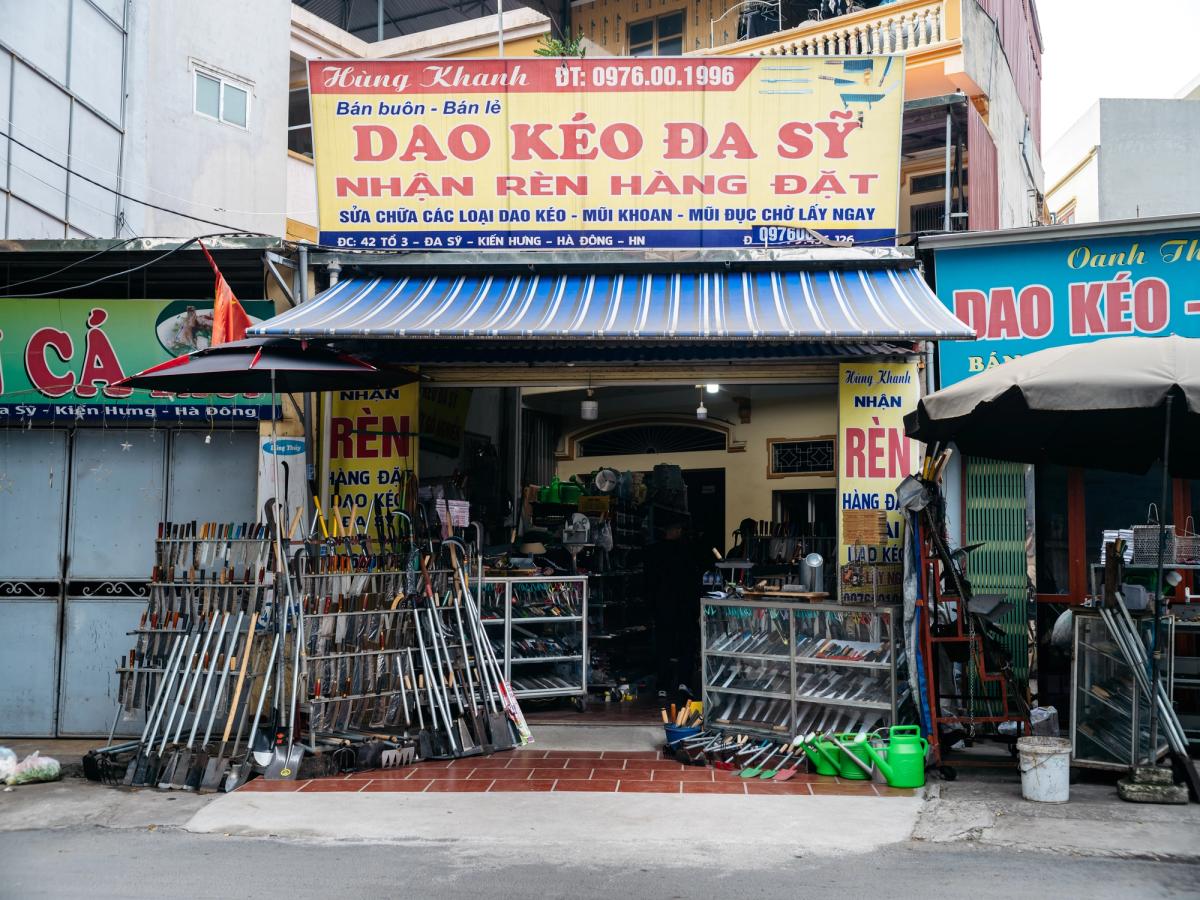
Climate, soil, altitude, crops, foodways, and local practices shape the needs and tools. Yet these objects are not immobile; they circulate. This is how knives from blacksmithing villages such as Đa Sỹ can be found across Việt Nam.